Spiral curriculum, a concept widely attributed to Jerome Bruner, refers to a curriculum design in which key concepts are presented repeatedly throughout the curriculum, but with deepening layers of complexity, or in different applications. Such treatment allows the earlier introduction of concepts traditionally reserved for later, more specialized courses in the curriculum, after students have mastered some fundamental principles that are often very theoretical and likely to discourage students who are eager to apply the concepts they are learning to real-world applications.
Source: J. S. Bruner, The process of education. Cambridge, MA: Harvard University Press, 1960.
The scenario in the shop goes like this;
Employer
I've shown you how to do that!
Employee
No, you never did.
If you send a link of our video and the employee watches you have a record. Now you can say: I have shown you that and back it up!
It works with 5 minute Micro-training videos. These videos can be used individually or assembled into a custom curriculum.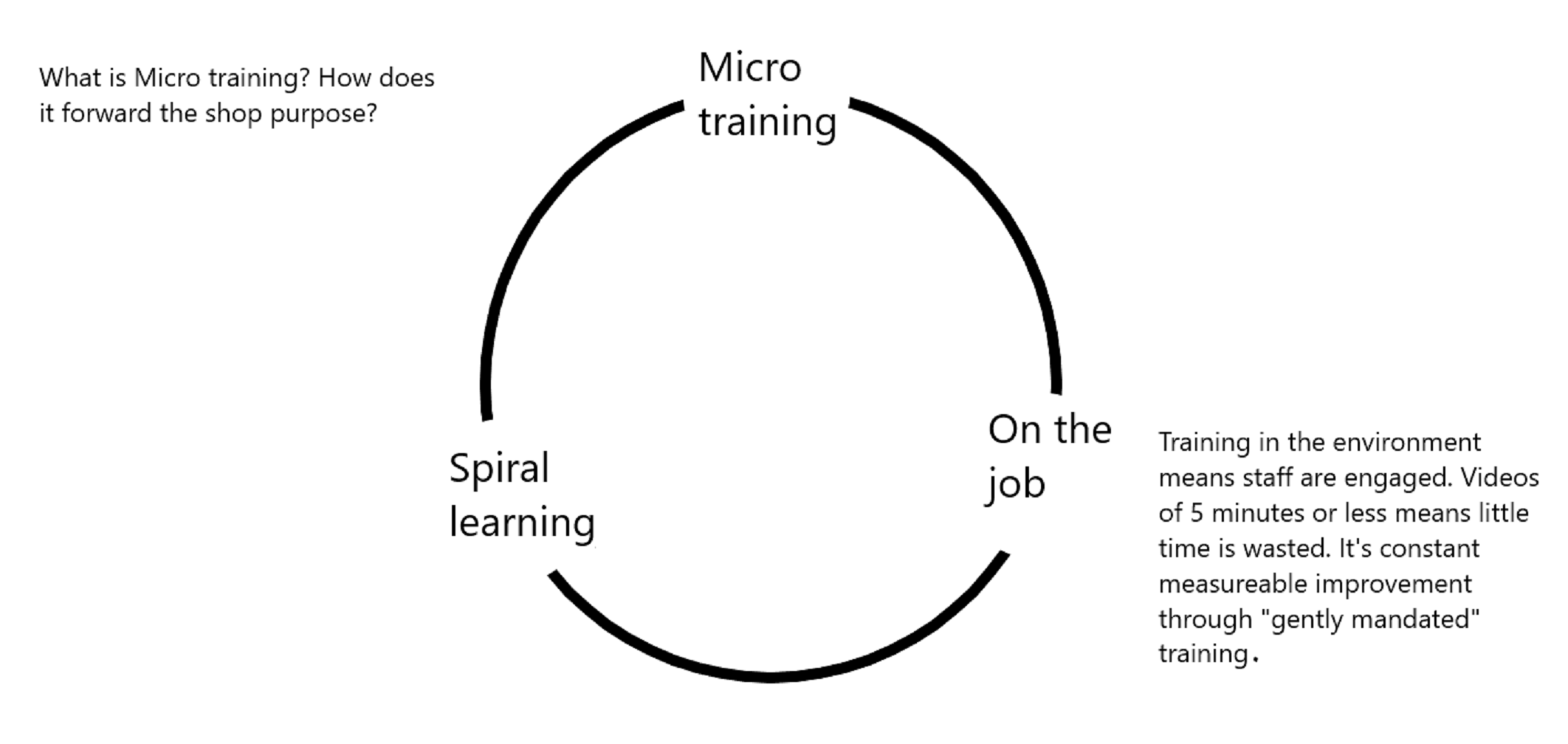 They can be re-visited again and again. Identification videos usually less than a minute long to make a shop helper into a retriever saving you steps. Identify tooling to make an entry level person capable of populating a tool list or assembling and indicating a vise.
Make an entry level staffer into an operator, an operator into a set up person.
Get more of what you pay for!
That's why we say,
We keep the spindles turning while the staff is learning!